
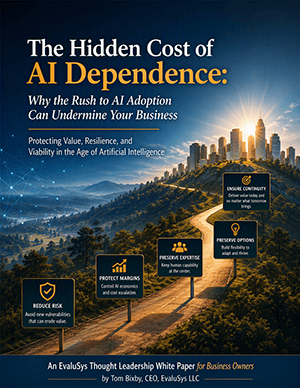
Artificial intelligence is transforming the way businesses operate, but what happens when a company becomes dependent on AI capabilities it does not own or control?
As part of the EvaluSys Thought Leadership Series, The Hidden Cost of AI Dependence: How the Rush to AI Adoption May Put Business Viability at Risk examines the often-overlooked risks of AI dependence, including vendor lock-in, loss of organizational capability, margin pressure, and threats to long-term business value. The paper offers practical strategies for building AI resilience while continuing to benefit from innovation.
Authored by EvaluSys CEO, Tom Bixby, the paper challenges the assumption that rapid AI adoption is an unqualified competitive advantage. The paper argues that while AI can dramatically improve productivity, businesses risk becoming dependent on external intelligence they do not own or control, creating vulnerabilities similar to owner dependence, supplier concentration, or key-employee risk. It explains why access to multiple AI vendors does not automatically eliminate this exposure, explores the difference between technical portability and true business-outcome portability, and outlines the operational, financial, and strategic risks that can emerge when AI becomes embedded in critical processes. Most importantly, it provides practical guidance for building AI resilience by preserving business knowledge, maintaining human capability, qualifying alternative models, and ensuring the company remains viable, valuable, and transferable even if the source, behavior, availability, or economics of AI changes.
The Hidden Cost of AI Dependence was written as an educational resource for business owners, and their advisors. Its purpose is to encourage business owners to adopt AI with the same discipline they apply to other critical business dependencies.